

Lifting Heavy Without Fear: What Research Actually Says About Weightlifting and Your Pelvic Floor
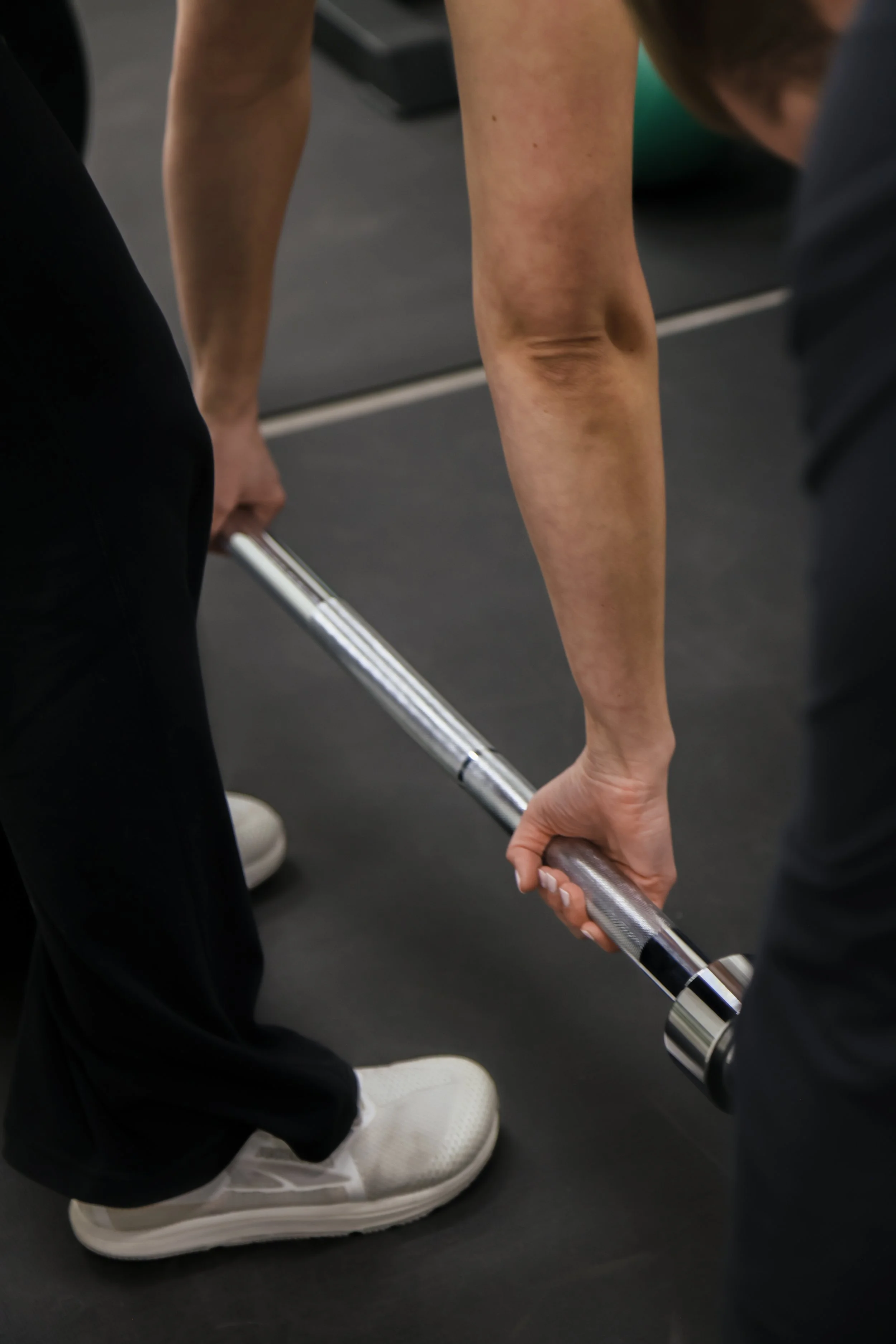
If you've ever loaded up a barbell and paused for half a second — wait, is this going to make me leak? Could this cause a prolapse? — you're not being paranoid. You've probably absorbed years of online advice telling you heavy lifting is dangerous for your pelvic floor. That advice has been floating around gyms and doctor's offices forever. But it was built more on assumption than actual evidence. The newer research tells a more useful story, and it's not the scary one you've heard.
The Old Story vs. What's Actually Happening
Think of your pelvic floor like any other muscle group in your body, say, your shoulders. Nobody tells you to avoid overhead pressing forever because it might strain your shoulder. You build capacity, you load progressively, you fix technique issues if they show up. Your pelvic floor works the same way. It's not a fragile hammock waiting to fail under a barbell… it's a trainable muscle group that adapts to demand, same as everything else in your body. Your pelvic floor also works together with many muscles, connective tissue, and your nervous system, making it extremely dynamic in how it functions!
What a new Study Found
A 2026 study out of the International Urogynecology Journal (Forner et al.) put this to the test directly. Researchers used ultrasound imaging on premenopausal women who'd had vaginal births and were experienced lifters, scanning them immediately before and after a genuinely heavy session (five sets of five barbell back squats at 80% of their one-rep max). That's not a light warm-up; that's a hard training day.
What they found: only small, immediate changes in pelvic floor structure, with bladder neck position, rectal support, and vaginal wall measurements all staying stable. In other words, in trained women without symptoms, one heavy squat session didn't meaningfully compromise organ support.
A separate crossover trial backs this up. Researchers compared heavy squats and deadlifts (75–85% of one-rep max) to just sitting and resting, and found no significant change in pelvic floor strength or resting pressure either way. Their takeaway: heavy compound lifts were well tolerated by the pelvic floor in healthy, experienced lifters!!!
And on the training side, a systematic review and meta-analysis of pelvic floor muscle training in female athletes found something genuinely encouraging: structured pelvic floor training significantly increased muscle strength and significantly reduced involuntary urine loss (incontinence). Your pelvic floor responds to training the same way your quads or your grip do. It gets stronger with the right input.
The Part I'm Not Going to Gloss Over
Here's where I want to be straight with you, because a tidy headline isn't the same thing as the full picture. Other research shows something more complicated, and pretending it doesn't exist wouldn't be doing you any favors.
A 2025 systematic review of competitive powerlifters and weightlifters found urinary incontinence rates around 41–49% in powerlifters and 37–54% in weightlifters, with squats and deadlifts showing up most often as the trigger. A related scoping review found the highest documented rates of pelvic organ prolapse were among powerlifters and Olympic weightlifters, suggesting sustained, very heavy, competition-level loading may be a real, modifiable risk factor, right alongside the much bigger, non-modifiable one: vaginal childbirth.
So which is it? Both are true, and they're not actually contradictory once you separate the variables:
A single heavy session, in a trained and asymptomatic lifter, looks low-risk. That's what the morphometry study and the crossover trial show us.
Sustained, maximal, competition-level loading over months and years — especially without good pelvic floor coordination — tracks with meaningfully higher rates of leaking and, sometimes, prolapse symptoms. That's what the powerlifting and weightlifting reviews show us, but again does not give us the full picture of what their form, breathing strategy, and crosstraining might look like (these are where the missing pieces might be for potential pelvic floor therapy intervention to improve).
This isn't really a "lifting vs. no lifting" story. It's a dose, technique, and preparedness story: how well your pelvic floor has been trained to handle the specific demand you're asking of it. And that's exactly the kind of nuance a Google search can't give you, but a movement-minded pelvic floor PT can (hi!😊).
What Actually Changes the Risk-Benefit Picture
How you manage pressure, not just how much you lift. Bracing strategy, breath timing under load, how well your rib cage can move, what your pelvis/ribcage ratio is like to allow pressure to move through it, etc. all matter as much as the number on the bar.
Progressive loading. Jumping straight to near-maximal lifts without building a base is a different animal than a well-programmed progression.
Symptoms as data, not something to grit your teeth through. Leaking, heaviness, bulging, or pelvic pain during or after lifting are your body telling you something — not obstacles to push past with a tighter brace.
Life stage and history. Postpartum recovery, prior pelvic floor injury, and menopause-related tissue changes all shift how much load your system is ready to handle right now.
Bottom Line
For most women, weight lifting is not something to fear, and skipping the weight room isn't usually the protective move it might feel like. Your pelvic floor is a muscle group — it can be undertrained, overwhelmed, or well-coordinated, and the goal is that last one. The research doesn't say "never lift heavy." It says dose, technique, and preparation are what separate a strong pelvic floor from a strained one.
That said, a blog post can't feel your pelvic floor contract, watch your breath pattern under a heavy squat, or know your specific delivery and training history. If you've never worked with a pelvic floor PT who actually thinks about movement — someone looking at your whole body, not just doing internal work in isolation — this is exactly where that kind of eye pays off. If you're feeling lost on where to even start, whether that's getting back under the bar postpartum, training for your first meet, or just not sure if what you're feeling is normal, I'd love to help you figure it out. Book an evaluation and let's build a plan around your body, not a worst-case warning you read online!
Research References
Forner, L. B., Cyr, M-P., Beckman, E. M., Hodges, P. W., & Smith, M. D. (2026). The Immediate Impact of Heavy Weightlifting on Pelvic Floor Morphometry in Vaginally Parous Women: A Repeated Measures Study. International Urogynecology Journal.
Acute Effect of Heavy Weightlifting on the Pelvic Floor Muscles in Strength-Trained Women: An Experimental Crossover Study.Read full text
Rodríguez-Longobardo, C., López-Torres, O., Guadalupe-Grau, A., & Gómez-Ruano, M. Á. (2024). Pelvic Floor Muscle Training Interventions in Female Athletes: A Systematic Review and Meta-analysis.Read abstract
Influence of Powerlifting and Weightlifting on Female Pelvic Floor Dysfunction: Systematic Literature Review. International Urogynecology Journal (2025). Read abstract
Strenuous Physical Activity, Exercise, and Pelvic Organ Prolapse: A Narrative Scoping Review. International Urogynecology Journal (2023). Read full text
This post is for educational purposes and isn't a substitute for an individualized evaluation.
