

Feet First: What Research says about the foot connection to the Pelvic Floor
When most people think about pelvic floor health, they picture…well, just the genital area. But here’s the thing: your pelvic floor doesn’t live on an island. It rarely works in isolation and is constantly communicating with other parts of your body. Believe it or not, your feet and ankles are some of its loudest neighbors.
The way you land, push off, and even the shoes you lace up can change how your pelvic floor muscles function. Think of your body like a slinky: if you pull or twist one end, the other end reacts. Every step you take sends a ripple of force up the chain.
Force Absorption 101
When your foot hits the ground, the impact doesn’t just stop there. Your toes, arches, and ankles are designed to absorb and spread that force. Done well, the load is shared and dissipated as it travels up through your knees, hips, pelvis, and spine. Done poorly—say you’re in stiff shoes, your ankles are tight, or you’re always landing on your heels—that force travels upward in a less-controlled way, and your pelvic floor often ends up taking more of the hit than it should and overtime that leads to pain/dysfunction.
The Fascial Connection
It’s not just bones and joints at work. There’s a fascial “highway” running through the center of your body called the Deep Front Line. It starts at the inner arch of your foot, travels through the tibialis posterior (a deep ankle stabilizer), up your inner thigh, through the pelvic floor, diaphragm, and even into the tongue. Wild, right? This continuous band of fascia means your foot mechanics aren’t just about balance—they’re literally tied, via connective tissue, to how your pelvic floor engages and responds.
Ankle Position Matters
A systematic review by Kannan et al. (2018) showed that when your ankle is flexed upward into dorsiflexion (toes pulled toward your shin), pelvic floor contractions are stronger. In contrast, plantarflexion (like wearing high heels) reduces resting pelvic-floor activity. In other words: your foot and ankle position can reflexively cue the pelvic floor to join in and absorb force.
Another case-control study from 2024 by Celenay, Yardimci & Altay suggests that women with a pes planus type foot (think, flat arch + ankle sort of rolling inward a bit) have increased functional pelvic floor symptoms, such as incontinence.
García‑Arrabé’s study (2022) also demonstrated that footwear allowing natural ankle motion and toe splay increases pelvic floor engagement, especially at faster running speeds. Similarly, Jarząb et al. (2018) found that restricting ankle mobility or wearing shoes with a high heel pitch can reduce pelvic floor activation. Together, these studies highlight a clear link: the way your foot moves and absorbs impact can either enhance or hinder pelvic floor function.
Running Adds Intensity
The faster you go, the more ground reaction force your body must manage. Picture your pelvic floor as the mat of a trampoline: the harder and faster the bounce, the more it has to respond. Research confirms that pelvic floor activation increases at higher running speeds, essentially acting as a built-in shock absorber with every step.
The previously mentioned study by García‑Arrabé et al. found that shoes restricting foot and ankle motion reduce intrinsic foot muscle engagement, altering how forces travel up the kinetic chain. Also, a systematic review of female athletes (Rojek et al., 2018) concluded that foot and ankle mechanics, as well as training load, play a significant role in pelvic floor symptoms.
Cadence as a Tool
Biomechanics research (Heiderscheit et al.; Musgjerd et al.) shows that increasing step rate (cadence) by 5–10% reduces vertical loading rates and peak impact forces at the leg and hip. Less impact at the ground means less shock traveling up the chain—and less extra load dumped on your pelvic floor.
Shoes Set the Stage
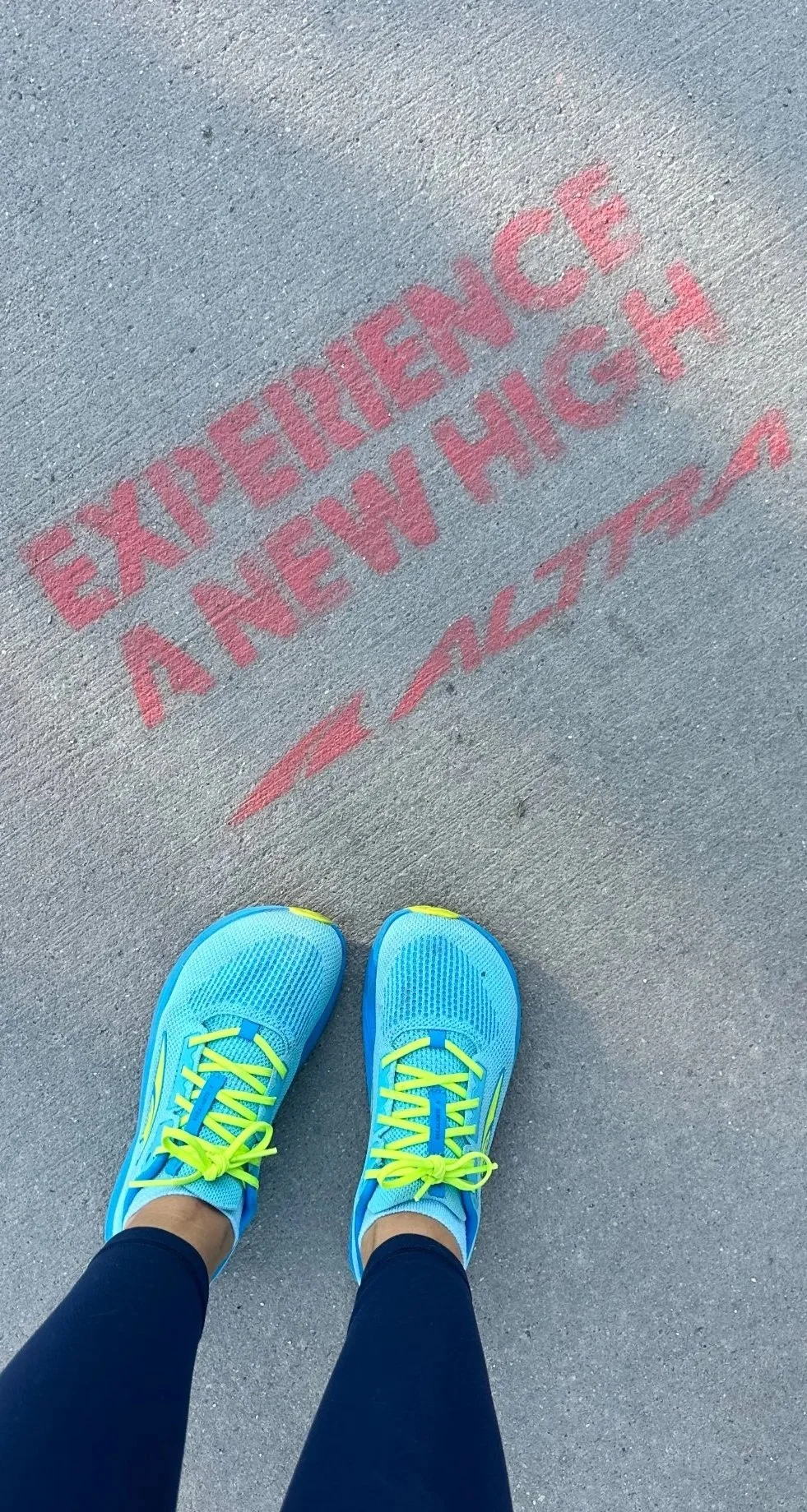
Your footwear decides whether your feet and ankles can actually do their shock-absorbing job. Minimalist or zero-drop shoes, such as my favorite brand to recommend, Altra, allow your toes to splay and your ankle to move naturally, which keeps the whole kinetic chain—from feet to hips to pelvic floor—online. Chunkier or high-heeled shoes pitch you forward, limit calf and ankle range, and often dampen foot engagement. Over time, this can make your pelvic floor work harder than it should, potentially contributing to symptoms such as urine leakage, pelvic heaviness, or lower-body discomfort.
A different study done by García‑Arrabé and colleagues directly tested this idea. They had nulliparous women run in minimalist vs. traditional running shoes and measured pelvic floor muscle (PFM) activity with EMG sensors. Minimalist shoes increased pelvic floor activation, particularly at faster running speeds, and also improved cadence and hip/femur motion. In other words, when the foot and ankle move naturally, the pelvic floor “joins the team” more effectively.
Altra Running Shoes in particular are designed to combine comfort, with natural alignment. Their FootShape™ toe box and zero to low-drop platform encourage proper ankle and foot mechanics, which can support better pelvic floor activation—especially for runners or anyone who is active. They’re not a magic cure, but paired with movement strategies and pelvic floor awareness, they’re a helpful piece of the puzzle.
Most shoes have a little built-in heel lift, which tips your foot forward without you even realizing it. A zero-drop shoe is different: the heel and toes sit at the exact same height from the ground. That means your foot rests flat—closer to how it would if you were barefoot. Zero-drop doesn’t mean “no cushion” (some have plenty of padding), it simply means there’s no slope from heel to toe. For many people, this design can encourage a more natural walking and running posture. If you aren’t used to a zero drop shoe, Altra offers a 4mm drop as a transition point, like the Experience line or FWD VIA would be appropriate (both have a toe rocker and are great for runners). If you want to go straight into it with a zero drop, I personally love both the Solstice & Escalante shoes, but beware - the Solstice have minimal cushion, so they can be a big transition into zero drop, wide toe box AND minimal cushion all at once - closest to a barefoot shoe. If you want more cushion, but zero drop, your best bet would be the Torin or the Lone Peak. In my opinion, you can’t go wrong when it comes to which Altra shoe to pick - it just depends on the activity you want to do in them and what shoes you are used to wearing currently!
Bottom Line
Every time your foot hits the ground, your pelvic floor feels it. If your feet can’t move well, your pelvic floor may end up picking up the slack—often leading to pain, tightness, or dysfunction. Research shows that giving your foot the freedom to move naturally and maintaining ankle mobility improves pelvic floor engagement and helps manage the forces traveling up the kinetic chain. Supporting your feet with the right footwear and movement strategies makes a difference in overall pelvic floor health.
Research References
Kannan, P., et al. (2018). Effect of ankle position on pelvic floor muscle contraction: A systematic review and meta-analysis. Disability and Rehabilitation, 40(20), 2376–2384. Read full text
García‑Arrabé, M., et al. (2022). Effects of minimalist shoes on pelvic floor activity in nulliparous women during running at different velocities: A randomized cross-over trial. Scientific Reports, 12, 18146. Read full text
Jarząb, S., et al. (2018). Impact of wearing high-heeled shoes on pelvic floor muscle activity and incontinence. Scientific Reports, 8, 17550. Read full text
Rojek, P., et al. (2018). Pelvic floor dysfunction in female athletes: Systematic review. Neurourology and Urodynamics, 37(6), 1805–1815. Read abstract
Heiderscheit, B. C., et al. (2011). Effects of step rate manipulation on joint mechanics during running. Medicine & Science in Sports & Exercise, 43(2), 296–302. Read abstract
Musgjerd, S., et al. (2014). Influence of cadence changes on lower limb kinetics during running. Journal of Biomechanics, 47(10), 2359–2364. Read abstract
Celenay, S. T., Yardımcı, F. N., & Altay, F. (2024). Pelvic floor muscle strength and dysfunctions in women with pes planus: A case-control study. European Journal of Obstetrics & Gynecology and Reproductive Biology, 296, 209–214. https://doi.org/10.1016/j.ejogrb.2024.01.019
